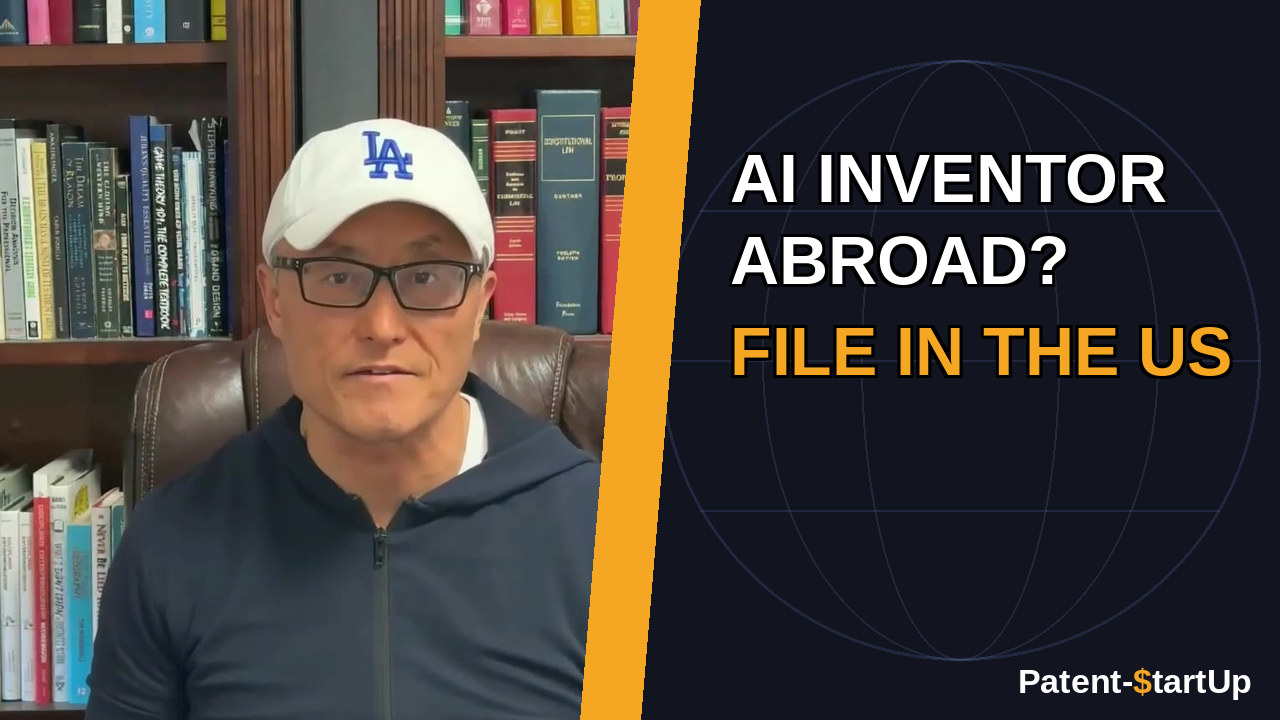
Foreign inventors — if you’re in Italy, India, Hong Kong, or anywhere outside the United States, here’s something your local patent attorney may not tell you: your cheapest first patent filing is probably not in your own country. It’s in the US, at roughly half the cost, with more options.
I’m Sung Oh, a USPTO-Registered Patent Agent (Reg. No. 45,583). I’ve started three companies, litigated my own patent to a seven-figure settlement, and licensed my patents to my own competitors. Every month I talk with inventors in Italy, Egypt, the UAE, and Hong Kong who assume they must file at home first — and pay full price for it.
Here’s what the numbers actually say in 2026.
There Is No World Patent — So Where Should You File First?
Patents are territorial. An Italian patent protects you in Italy, and nowhere else. If an American company copies your product in Chicago, the only patent that helps you is a US patent.
For AI inventions this matters even more: the market — the license deals, the investors, and the infringers — is concentrated in the US and China. For most individual foreign inventors, enforcing a patent in China isn’t realistic. Realistically, the US is the market that matters.
The US Secret Weapon: The Provisional Application
Most countries give you exactly one way to file — the full application. Complete claims, full fees, one shot.
The United States gives you two. There’s the non-provisional (the “real” application), and there’s the provisional — and almost no other country has anything like it. Australia, India, and New Zealand do. The European Patent Office doesn’t, and neither do the national offices in Europe, like Germany’s. China and Japan don’t either.
What a Provisional Actually Is
A provisional is not a real patent application. It isn’t examined, and no claims get allowed. What you get is a priority date for whatever you disclosed.
If you disclose your invention clearly and completely, that date is locked in. You then have 12 months to file the non-provisional — which claims the provisional’s priority date, gets examined, and is where your claims are actually granted. Miss the 12-month deadline and the provisional expires.
Think of it as a placeholder: cheap and fast, but you must convert it within a year.
The Real 2026 Numbers
Here’s the math for your first filing, all-in:
- US provisional: ~$2,100. AI-assisted drafting runs around $2,000, plus a government fee as low as $65 for a micro entity — and most individual foreign inventors qualify.
- Germany: €3,400–6,400. No provisional exists, so you pay for the complete application up front — roughly €3,000–6,000 in attorney drafting plus about €400 in official fees.
- Europe (EPO): €8,000+. Attorney drafting plus €1,655+ in official fees just at filing (about €6,000 in official fees to reach grant) — before validating country by country.
That’s the 50% saving: your first filing, done in the US as a provisional, at about half of what a European first filing costs.
What the Provisional Buys Beyond Savings
For 12 months you have “Patent Pending” and a locked priority date — which matters for AI, because there’s a race to file first. You get a year to improve the invention and fold the improvements into the real application. And if the idea doesn’t pan out? Drop it. You’ve spent $2,000, not six.
The Multiple-Provisionals Strategy My AI Startup Clients Use
Nobody knows which AI idea will win. So my startup clients file multiple provisionals on different AI inventions, wait the year, and file a non-provisional only for the best one.
Founders do what founders do: back several ideas, pick the winner, and pursue it. Lock your priority date cheaply, decide later, and put the savings into your product.
The First-Filing Trap: Check Before You File Anything
Before you rush to the USPTO — one trap. Some countries restrict where your first filing can go. The rules fall into three buckets:
- Broad restrictions (every invention): France, Italy, India, China, Spain, and others. File at home first or get permission. Italy, for example — your Italian application must be at least 60 days old before you go international.
- Military-related only: the UK, Germany, South Korea, Japan. An ordinary AI or consumer invention is free to file US-first.
- No restriction: Canada, the Netherlands, the UAE, Brazil, and more. File anywhere — including straight to the USPTO.
The official country-by-country list is maintained by WIPO: National security provisions in national patent laws. It’s a five-minute check — and skipping it can void your patent. I’m licensed before the USPTO, not in your country, so confirm your home rule with a local patent professional.
One More Thing for AI Inventions: Section 101
Every major patent office has some version of an “abstract idea” rule — computer programs and mathematical methods as such are harder to patent. The US Alice test used to be the toughest; it’s more relaxed now, but you still need to write an AI application a specific way for a better chance of allowance. That’s a big part of my work with foreign inventors. I cover it in detail here: Why 77% of AI Patents Get Rejected.
Common Questions From My International Clients
Is everything remote? Yes — my clients in Italy, Egypt, the UAE, and Hong Kong have never set foot in my office.
Can my foreign company be the applicant? Yes, with you named as inventor. There’s no US-residency requirement.
Is my invention confidential? Yes — and your materials are never used to train AI models. Every application is reviewed and filed by me personally.
Take the Next Step
If you already filed at home, or you drafted your invention with AI, don’t pay $5,000–$8,000 for a US firm to start from a blank page. You draft, we revise — that’s the Hybrid Model. Quality patent, lower cost.
Learn how to draft your application step by step in my free tutorial, or book a free consultation and let’s talk about your invention.
Disclaimer: I’m a registered patent agent, not your attorney. This article is educational and is not legal advice.