Seventy-seven percent of AI patent applications get rejected with a Section 101 “abstract idea” objection. By comparison, the software tech group sits at roughly 21 percent, and mechanical inventions at under 10 percent. [1]
The deck is stacked against AI inventors. But there is a way to win — and it comes down to how you draft your patent specification and your claims.
Where the 77% Rejection Rate Comes From
The 77 percent figure is from Voice of IP’s 2024 analysis of USPTO Office Action data, looking specifically at Working Group 2120 — the tech group that examines artificial intelligence, machine learning, and simulation/modeling applications. [1] That figure is more than double the 2022 rate, and roughly twenty points above the pre-2019 baseline.
Why is AI hit so hard? Because Section 101 of the Patent Act says abstract ideas cannot be patented. [2] When an examiner looks at an AI application, the surface impression is “math on a computer” — and math is the textbook example of an abstract idea. The examiner reaches for a Section 101 rejection because it is the path of least resistance.
How We Got Here: A Short History of Section 101
The pivot was 2014. In Alice Corp. v. CLS Bank International, the Supreme Court handed the USPTO a two-step test for figuring out whether an invention crosses the abstract-idea line. [3] After Alice, rejection rates for software and AI exploded. See the graph below.
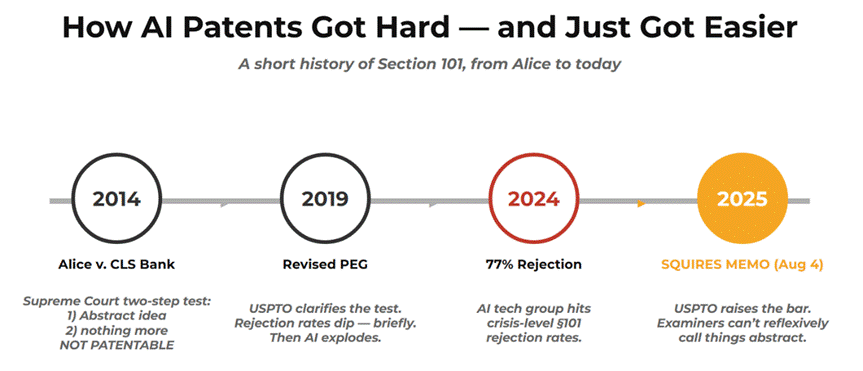
In 2019, the USPTO issued the Revised Patent Eligibility Guidance (PEG). [4] That helped — briefly. Then AI took off, applications flooded in, and Section 101 rejections climbed back up to where they are today.
On August 4, 2025, the USPTO issued what is now called the Squires memo, raising the bar for Section 101 rejections. [5] Examiners can no longer reflexively call something abstract at step one. If you draft the right way, your odds change dramatically.
The Alice Two-Step, Explained
Alice has two questions. Step one: is the claim directed to an abstract idea? If the answer is no, the claim is eligible — you are done. If the answer is yes, you move to step two. Step two: does the claim add significantly more than the abstract idea itself? If yes, the claim is eligible. If no, the claim gets rejected under Section 101. See the diagram below.
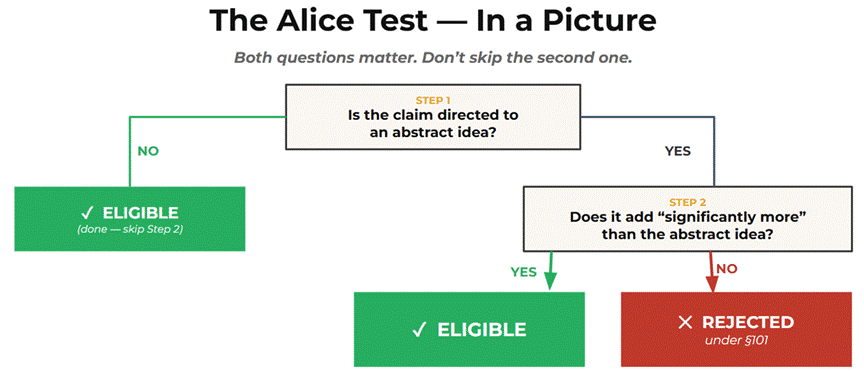
Two questions. Three possible outcomes. Two of the three paths lead to an eligible claim. Only one path — “yes” at step one and “no” at step two — gets you rejected.
And here is what most inventors get wrong: being called “abstract” at step one does not kill your patent. It just sends you to step two. Most well-drafted AI patents are abstract at step one. They survive at step two by giving the examiner something concrete to point to. That is why your specification matters.
The Three Pillars of a §101-Proof Specification
Pillar 1: Anchor to a Technical Problem
Do not describe what your AI does — describe the technical problem it solves. “Predicts loan risk” sounds abstract. “Reduces GPU memory by 40 percent while preserving gradient stability during backpropagation” sounds technical. The first will get a Section 101 rejection. The second probably will not.
Pillar 2: Architectural Specificity
Do not draft a black box. Disclose the architecture: the layer types, the attention mechanism, the loss function, the training recipe. “A neural network trained on data” loses. “A transformer with sparse attention reducing complexity from N-squared to N-log-N” wins. Specificity is eligibility.
Pillar 3: At Least One Non-Abstract Step
Your independent claim needs at least one step that a human cannot do in their head. A sensor input. An actuator output. A specific data-transmission step. A forward pass written in architectural terms. Under the 2025 Squires memo, the examiner cannot say “a human could do this in their mind” anymore — as long as you give them something concrete to point to.
The Three Levels of an AI Patent Claim: Weak, Better, Best
Once your specification clears Section 101, the next question is how to draft the claim. Three levels, illustrated with a hypothetical AI fraud detector that is 99 percent accurate in testing.
Weak: “a detection accuracy of 99 percent.” A competitor ships 98.5 percent and walks around the claim.
Better: “an accuracy between 90 percent and 99 percent.” A competitor ships 99.1 percent and walks around the claim.
Best: “an accuracy of at least 90 percent.” Anything 90 percent or higher infringes. Same invention, three very different fences. The best claim removes the ceiling — but only as far down as the prior art allows.
Why AI Drafting Tools Make All of This Worse
If you let an AI tool draft your patent application, three things go wrong. The specification reads abstract because the AI describes outputs, not mechanisms — that is a Section 101 rejection waiting to happen. The claim comes out weak because the AI writes specs like a product manager. And the AI cannot balance scope against the prior art, because it does not know your prior art.
Three judgment calls in a row — and AI does not make any of them well. That is why an experienced patent attorney or agent earns their fee on AI applications, especially right now.
Take the Next Step
I am Sung Oh, a USPTO-registered patent agent (Reg. No. 45,583). If you are an inventor or startup founder thinking about filing a patent — or you have already drafted an application with AI — that is exactly what our Hybrid Model is built for. You draft your application with AI, we revise it, and you end up with a quality patent at a lower cost.
Visit patentstartup.com to learn more, or send your invention notes to sung@patentstartup.com for a free initial review.
——————————————————————————————
References and Further Reading
[1] Voice of IP, “BREAKING: Section 101 Rejections Soar at USPTO; 77% of AI Tech Group’s OAs Include 101 Rejections” (2024). Analysis of USPTO Office Action data, Working Group 2120 (AI + Simulation/Modeling). Available at: https://www.voiceofip.com/p/breaking-section-101-rejections-soar
[2] 35 U.S.C. § 101 (Inventions patentable). The statutory basis for subject-matter eligibility. Available at: https://www.uspto.gov/web/offices/pac/mpep/s2106.html
[3] Alice Corp. Pty. Ltd. v. CLS Bank International, 573 U.S. 208 (2014). The Supreme Court case establishing the two-step test for patent-eligible subject matter. Available at: https://supreme.justia.com/cases/federal/us/573/208/
[4] USPTO 2019 Revised Patent Subject Matter Eligibility Guidance (“2019 PEG”), 84 Fed. Reg. 50 (Jan. 7, 2019). Refined the Alice/Mayo test and added Step 2A Prong Two. Available at: https://www.federalregister.gov/documents/2019/01/07/2018-28282/2019-revised-patent-subject-matter-eligibility-guidance
[5] USPTO, “Subject Matter Eligibility Examination” memorandum (the “Squires memo”), August 4, 2025. Raised the bar for Section 101 rejections, particularly in AI/software. Available at: https://www.uspto.gov/sites/default/files/documents/memo-101-20250804.pdf
——————————————————————————————
Disclaimer: I am a USPTO-registered patent agent (Reg. No. 45,583), not your attorney. This article is for educational purposes only and is not legal advice. Patent law is fact-specific; consult a qualified practitioner about your specific invention.