Most inventors think their patent is great. They are wrong — and they do not know it. The prior art that kills a patent does not live only in the United States. It lives in Europe, China, India, and every other major patent office in the world. You will not find it unless you search.
That is why I tell every client the same thing: spend five hundred to eight hundred dollars on a prior art search before you spend ten thousand dollars on a patent. With AI-assisted search software, the cost of a search has come down from over $3,000 to less than $1,000 — making it one of the highest-ROI decisions an inventor can make.
Prior Art Is Everywhere — Not Just the US
The patent office does not just look at US patents when deciding whether your idea is new. It looks at everything published anywhere in the world, in any language. That includes patents from Europe, China, India, Japan, and Korea — and every paper, product manual, and conference proceeding ever published.
When I run a search for a client, I search the same major patent offices: US, Europe, China, India. Almost every time, we find relevant prior art. Almost every time, the inventor had no idea it existed.
What a Patent Search Tells You: Strong, Average, or Weak
After a search, the result falls into one of three categories. Strong: the idea is novel, file with confidence. Average: there is some prior art, but we can draft around it. Weak: there is a patent or product that is already too close. You need to rethink the invention.
Even if the result is weak, the search is not wasted. We look at what is out there and figure out what novel feature you can build on top — something the prior art does not have. That feature becomes the new core of your claim.
The Real Math: $800 Search vs. $10,000+ Patent
Here are the numbers. A patentability search costs about five hundred to eight hundred dollars depending on the complexity of the invention. A full utility patent — drafting, filing, prosecution, allowance, and the first maintenance fee — runs ten thousand dollars and up, as you can see in the graph below.
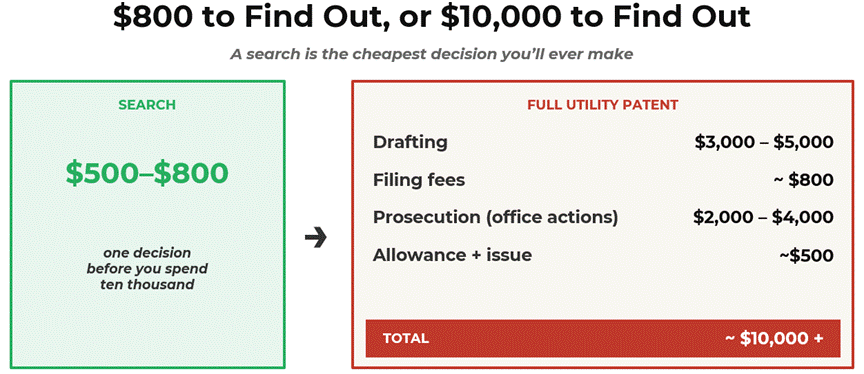
For a solo inventor or a startup with limited capital, that is serious money. The search is the cheapest decision you will ever make to find out whether the ten thousand dollars is worth spending.
What an Actual Prior Art Search Report Contains
A search report has five sections, but the most important parts are Sections 3, 4, and 5. To illustrate, I have included a sample search report from one of my own patents (U.S. Patent No. 11,944,568 and its international counterpart WO 2022/082076, both directed to a non-invasive cooling system for crystallizing subcutaneous fat). Because the patent is mine, no client confidentiality is disclosed — what you see is the actual unredacted deliverable a client receives.
👉 View the full sample search report (Fat-Loss Cooling System)
Section 3 — Prior Art References Reviewed. Roughly the ten most relevant references found in the search, each with the patent number, the assignee, a similarity score from 1 to 100, and the title. Below each reference is a write-up with the relevant text and the differences from the invention. In the sample, the highest-scoring third-party references are AbbVie’s cooling-cup applicator (US 2021/0045912 A1) and Zeltiq’s curved-applicator cryolipolysis device (US 2014/0364841 A1), both scoring 85/100.
Section 4 — Feature-by-Feature Patentability Analysis. Every novel feature is marked as Likely Novel (not specifically disclosed in prior art), Weaker (partially covered), or Anticipated (substantially covered). In the sample, of the nine novel features analyzed, five were marked Likely Novel, three were Weaker, and one was Anticipated.
Section 5 — Patentability Conclusions and Filing Recommendation. Walks through the two or three most relevant prior art references, what the patent office is likely to do with your application, and whether to file a provisional or non-provisional. For first-time inventors, a provisional is almost always the right starting point — twelve months to develop the invention before committing to the full non-provisional cost.
Other patent attorneys and agents use different report structures, but the substance is similar: a clear, evidence-based assessment of whether your invention is novel against the global prior art.
Bottom line: the search gives you the facts about the novelty of your invention so you can decide whether it is worth filing.
Take the Next Step
I am Sung Oh, a USPTO-registered patent agent (Reg. No. 45,583). If you are an inventor or startup founder thinking about filing a patent — or you have already drafted an application with AI — that is exactly what our Hybrid Model is built for. You draft your application with AI, we revise it, and you end up with a quality patent at a lower cost.
Visit patentstartup.com to learn more, or send your invention notes to sung@patentstartup.com for a free initial review.
——————————————————————————————
References and Resources
[1] Sample Search Report (Fat-Loss Cooling System) — full PDF: https://drive.google.com/file/d/1PjV67OuT9US4KvzxRs80XDdWsi_BGzJw/view?usp=drive_link
——————————————————————————————
Disclaimer: I am a USPTO-registered patent agent (Reg. No. 45,583), not your attorney. This article is for educational purposes only and is not legal advice. Patent law is fact-specific; consult a qualified practitioner about your specific invention.