Most inventors have no idea whether the patent they are about to file is strong or weak — until it is too late. They pay ten thousand dollars or more to draft, file, and prosecute an application, only to discover that competitors can design around the claims with ease, or that the examiner rejects the claims because they collide with prior art the inventor never knew existed.
In this article, I will walk you through the single rule that separates a strong patent claim from a weak one. I will use the same example I use with my own clients — Ford and Harley-Davidson — and explain why so many AI-drafted patent applications fall apart in prosecution.
What a Patent Claim Actually Is
A patent has two parts: the specification and the claims. The specification tells the story of your invention — what problem it solves, how it works, the embodiments you considered. The claims are different. The claims are what you actually own.
A claim is a single sentence. Inside that sentence, you list every element your invention requires. If a competitor’s product contains every single one of those elements, the competitor infringes your patent. If their product is missing even one element, they walk away.
That is the whole game. Now let us see why it matters.
The Ford vs. Harley-Davidson Example
Imagine Henry Ford files a patent on the Model T in 1908. His claim covers three elements: an engine, a transmission, and four wheels. A few years later, Harley-Davidson files a patent on the motorcycle: engine, transmission, and two wheels.
Does the motorcycle infringe Ford’s patent? The answer is NO.
Ford’s claim requires four wheels. The motorcycle has only two. Because every element of Ford’s claim is not present in the motorcycle, there is no infringement. Both companies are free to sell their products.
The Reversal: Flipping the Fact Pattern
Now flip the order. Suppose Harley-Davidson files the motorcycle patent first, with just two wheels. Later, Ford files his patent on the Model T with four wheels.
Does the Model T infringe Harley’s patent? The answer is YES — but how, if the Model T has four wheels and not two?
Here is the trick. The Model T contains two wheels plus two more. It still has two wheels — and we do not care about the extra two, because Harley’s claim only requires two. Every element of Harley’s claim is present in the Model T, so the Model T infringes. A six-wheel truck would infringe for the same reason — it still contains two wheels. Extra wheels do not save you.
This is the rule that surprises every first-time inventor: fewer elements in your claim equals broader protection. Each element you add is another loophole a competitor can use to walk around your patent.
The Rule: Less Is More — But Only To a Point
So the rule is simple: less is more. A strong patent claim contains the fewest possible elements that still describe the inventive concept. The fewer elements you require, the more products fall inside your fence.
But you cannot push this rule to the extreme. If your claim is too broad — for example, “a vehicle with wheels” — the examiner will reject it, because the prior art already covers a vehicle with wheels (every bicycle, car, and wagon ever made). Your claim has to be narrow enough to be new, but no narrower than that.
The art of patent claim drafting is finding the narrow gap: broad enough to be valuable, but not so broad it collides with the prior art. This is judgment work. It takes an experienced patent attorney or agent who has read the prior art in your field and knows exactly how far to push before the examiner pushes back.
Why AI Drafting Tools Write Weak Patent Claims
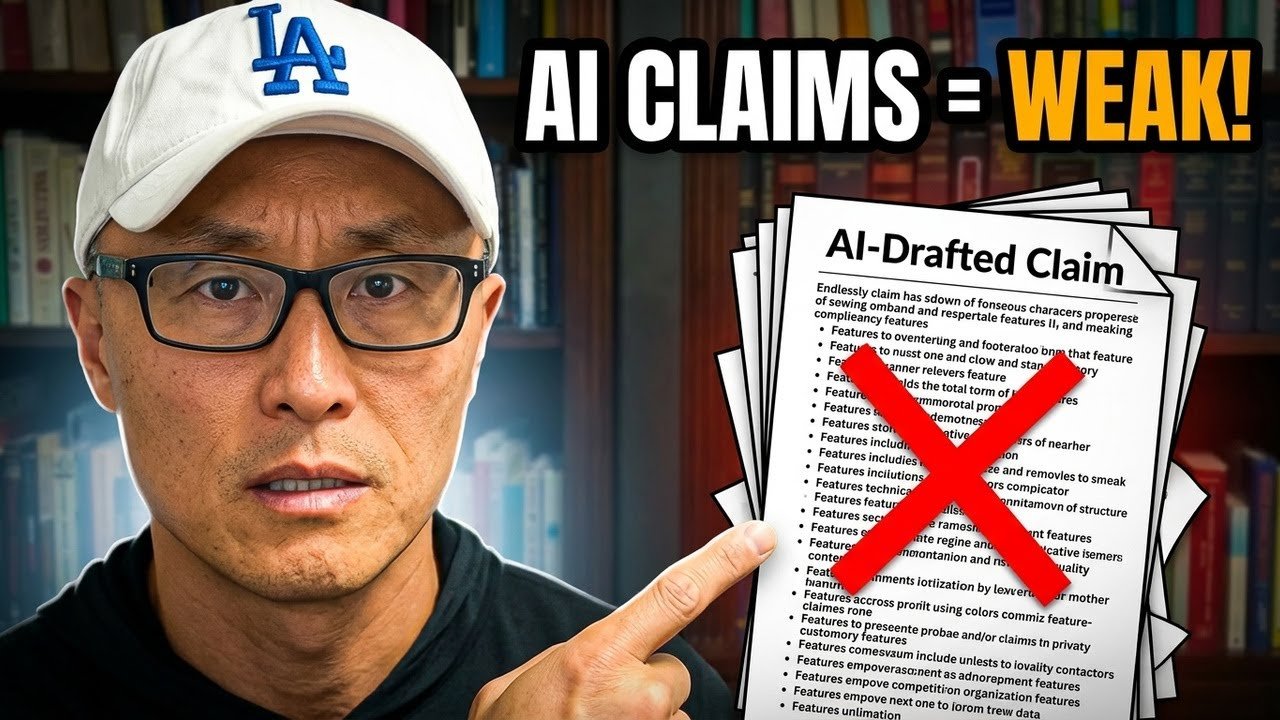
I have reviewed dozens of patent applications drafted by inventors using AI tools. Almost every single one has the same problem: the claims are too narrow.
Here is why. AI tools read your product description and dump every feature into the claim. Ten, fifteen, twenty elements. To the inventor, this looks thorough. To a patent attorney or agent, this looks like a claim that protects nothing — because a competitor only needs to skip one element to escape the claim.
AI tools also do not know the prior art. They cannot tell you which elements are truly essential to novelty, and which elements you can strip out without losing patentability. That judgment requires reading the prior art in your specific technical field. AI does not do that — at least not yet.
The result is predictable: the patent gets allowed (because narrow claims clear the prior art easily), but the patent does not protect anything. A competitor changes one feature and your patent is worthless. You spent ten thousand dollars for a piece of paper.
The Bottom Line
A strong patent claim is a balanced claim. Wide enough to capture serious competitors. Narrow enough to clear the prior art. The fewest elements possible, each one truly essential to the invention.
Getting that balance right is the difference between a patent that builds a business and a patent that builds a paperweight. It is also the difference an experienced patent professional makes — someone who has read the prior art, drafted hundreds of claims, and litigated patents in the real world.
Take the Next Step
I am Sung Oh, a USPTO-registered patent agent (Reg. No. 45,583). If you are an inventor or startup founder thinking about filing a patent — or you have already drafted an application with AI — that is exactly what our Hybrid Model is built for. You draft your application with AI, we revise it, and you end up with a quality patent at a lower cost.
Visit patentstartup.com to learn more, or send your invention notes to sung@patentstartup.com for a free initial review.
——————————————————————————————
Disclaimer: I am a USPTO-registered patent agent (Reg. No. 45,583), not your attorney. This article is for educational purposes only and is not legal advice. Patent law is fact-specific; consult a qualified practitioner about your specific invention.